The violin shoulder rest that holds steady and folds into your case
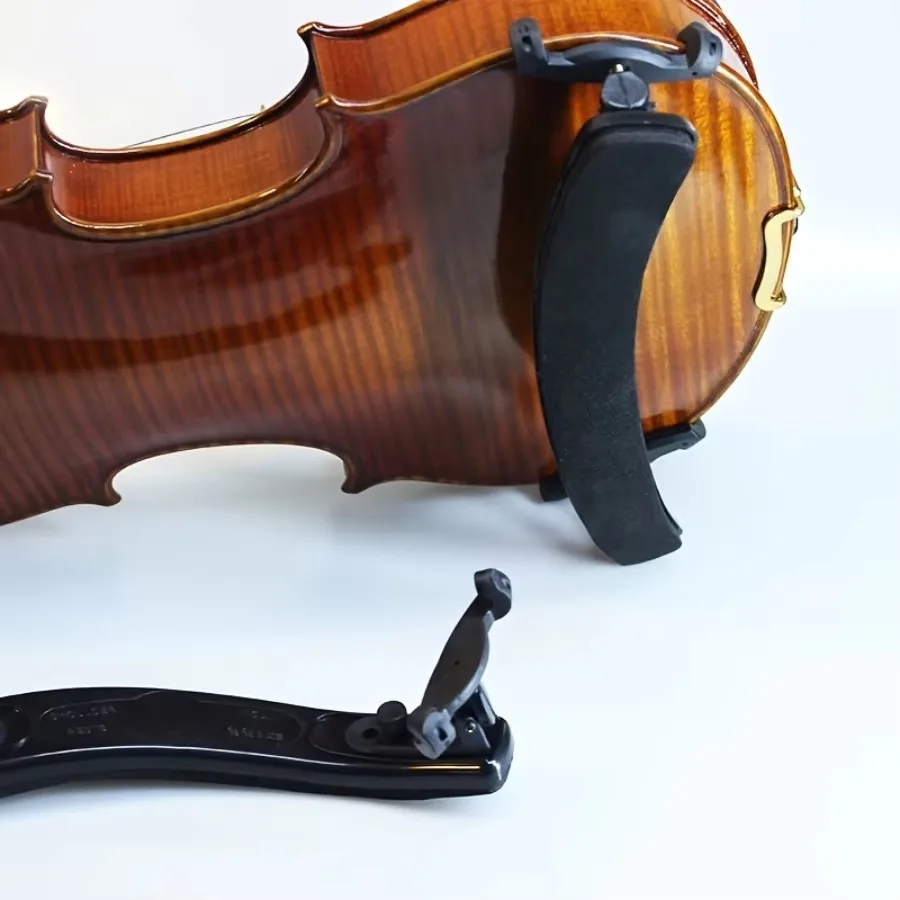
A foam-cushioned arch on foldable feet lifts the violin to your shoulder, so you can drop the clamp in your neck and play longer without aching.
Choose your size
⏳ Stock is running low on this batch
Secure checkout. You can review your cart before you pay.
Not sure which size? See the fit guide.
A steadier hold, without clamping your neck
When there is nothing between the violin and your shoulder, most players compensate by squeezing, and that tension is exactly what makes practice tiring. The foam-cushioned arch fills the space so the violin balances on its own. Your left hand is freed to move, your chin relaxes on the chinrest, and long passages stop feeling like a workout. It is the single most common accessory teachers recommend for beginners, and it is just as useful for players returning after years away.
For a deeper look at how a rest compares with a sponge or a pad, and why we build the one we sell, see our buyer's guide to the best violin shoulder rest.
Feet that fold flat for the case
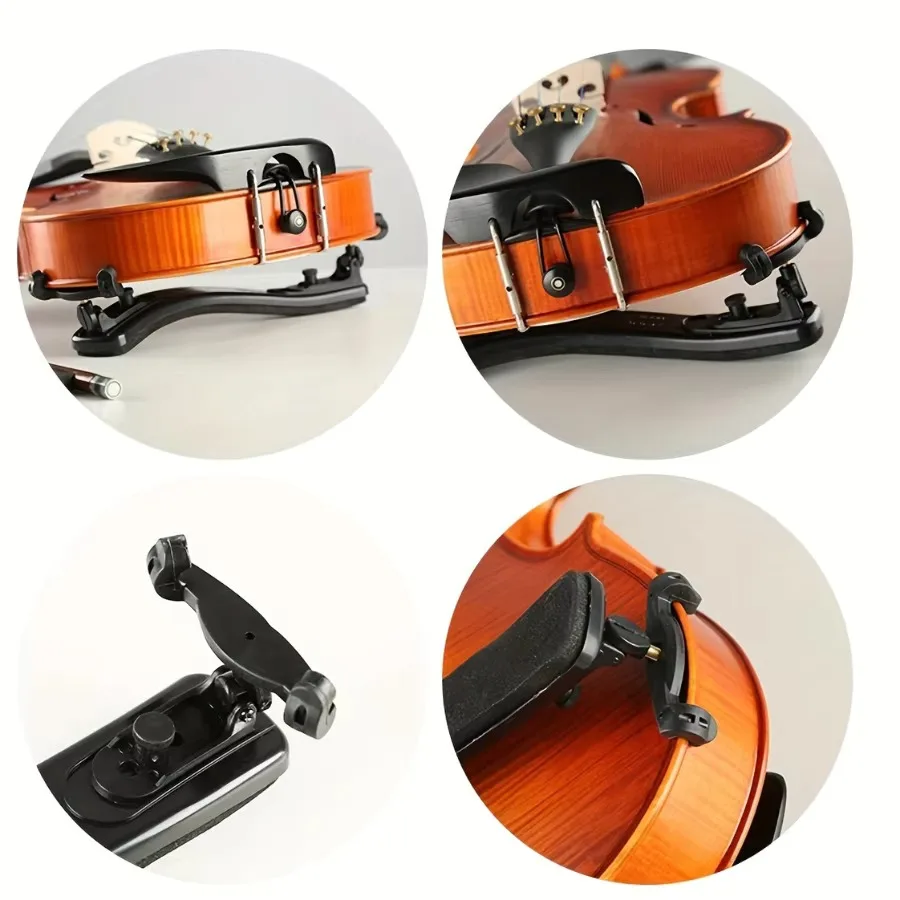
Rigid rests are a nuisance to pack. Cadenza folds down to a low profile that slides into the accessory pocket or lies alongside the neck of the violin. For students carrying an instrument to school and back, that means the rest travels with the violin instead of being left at home, which is usually why a shoulder rest goes unused in the first place. The joints hold their set position, so once you dial in your angle it stays where you put it.
On in about ten seconds
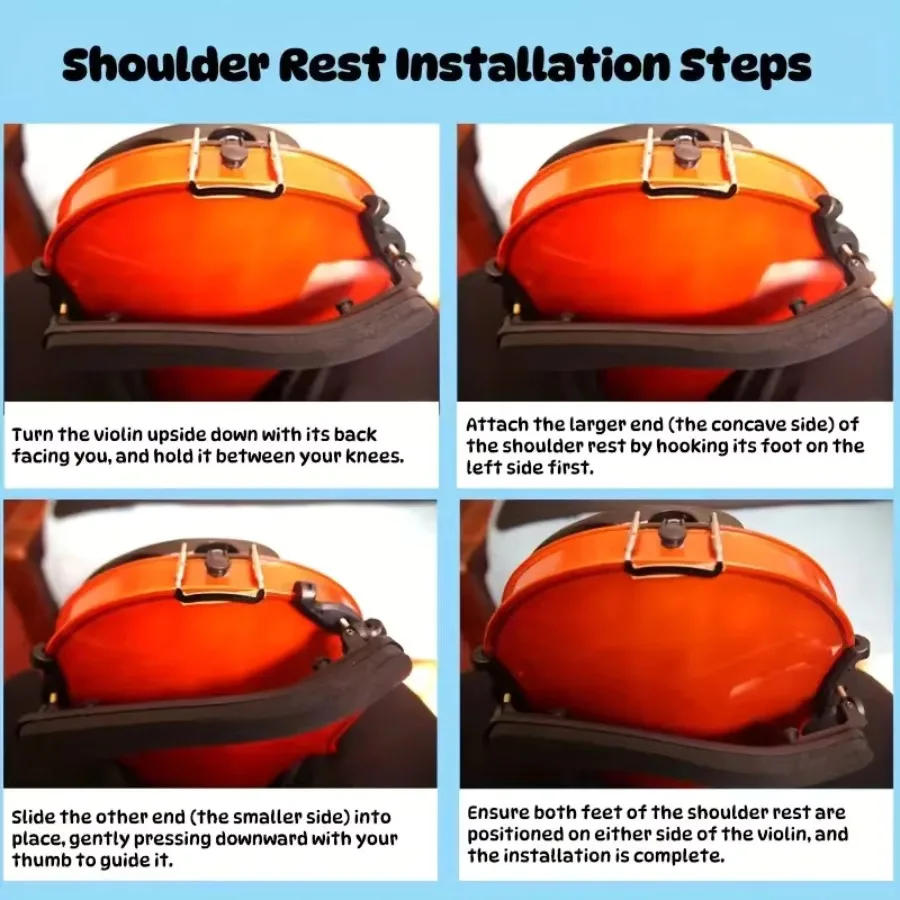
The feet are shaped to clamp onto the ribs, the thin sides of the violin body, so no tools and no sticky pads are involved. Seating them fully is what keeps the rest from shifting mid-practice, which is the one thing worth getting right. Our full guide to putting a shoulder rest on a violin shows each step with photos, plus how to take it off without scraping the varnish.
Match the rest to your violin size
| Violin size | Choose this model | Rest length |
|---|---|---|
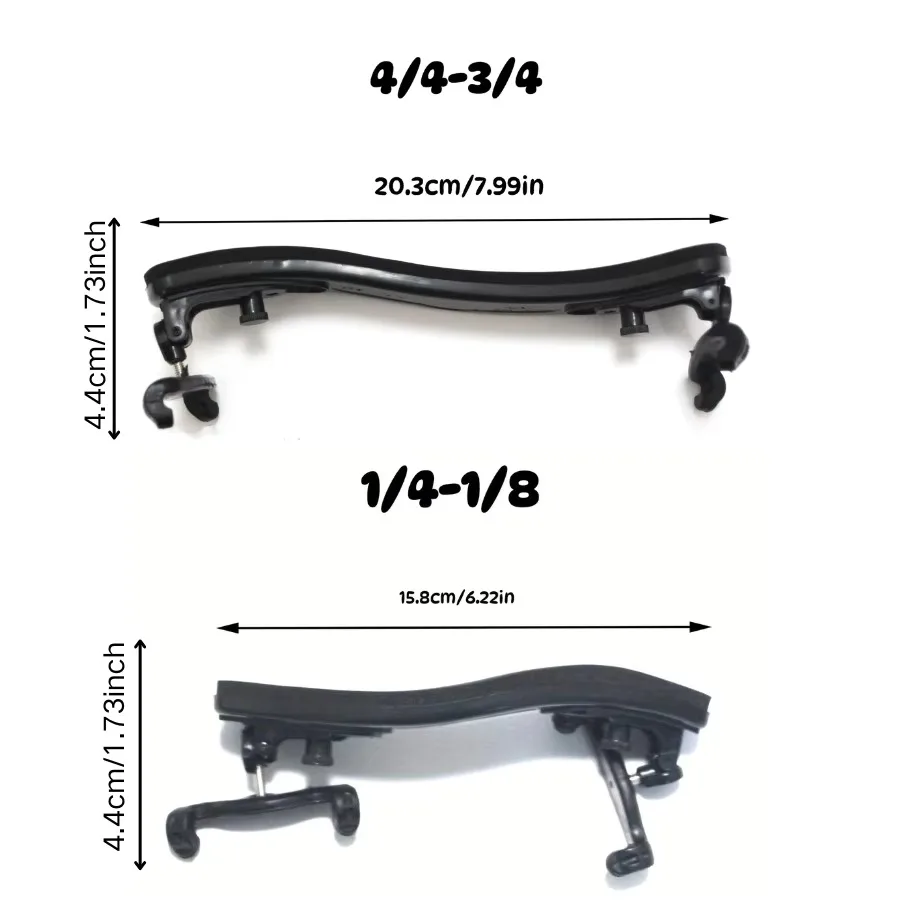
| 4/4 (full) | Full / Three-quarter | 20.3 cm (7.99 in) |
| 3/4 | Full / Three-quarter | 20.3 cm (7.99 in) |
| 1/2 | Not covered (see note) | n/a |
| 1/4 | Small | 15.8 cm (6.22 in) |
| 1/8 | Small | 15.8 cm (6.22 in) |
Both models stand 4.4 cm (1.73 in) tall at the arch.
About the 1/2 size: we want to be straight with you. There is a genuine gap between our two models, and a half-size violin falls into it. The Small model is built for 1/4 and 1/8 bodies and tends to be a touch short for a 1/2, while the Full / Three-quarter model can run a little large. A handful of 3/4 players with smaller instruments have also found the Full model sits at the roomy end of its range. If you are on a 1/2, or a compact 3/4, measure the width across the lower ribs and compare it with the lengths above, and reach out through our contact page if you would like a second opinion before ordering. Full details live on the violin shoulder rest sizes guide.
The details, measured
We list the real measurements rather than round numbers, because a shoulder rest that is a centimeter off is a shoulder rest that slides. The Full / Three-quarter model runs 20.3 cm along the arch and the Small model 15.8 cm, and both stand 4.4 cm tall where the foam meets your collarbone. The foam is on the thin side, so players with bony shoulders sometimes lay a thin cloth over it. That is the trade-off at this price, and we would rather say it up front than let you find out at home.
| Frame | Black plastic |
|---|---|
| Cushion | Foam pad over a slim metal core |
| Feet | Plastic with grippy tips, pivoting and foldable |
| Full / Three-quarter size | 20.3 cm long, 4.4 cm tall (fits 4/4 and 3/4) |
| Small size | 15.8 cm long, 4.4 cm tall (fits 1/4 and 1/8) |
| Adjustment | Feet pivot for width and angle; no height tower |
| In the box | One shoulder rest, ready to fit |
Compatible with violins only. It is not sized for viola, and a half-size (1/2) violin is not covered. See the sizes guide before ordering.
Neck and shoulder strain is the violinist's occupational hazard
The research on musicians is consistent about where the trouble shows up. Across studies, the neck and shoulders are the regions string players report most, and the left shoulder, the one under the violin, is a recurring hot spot. None of this means a plastic rest is a medical device. It means the position you hold the violin in, hour after hour, adds up, and a rest that lets the instrument balance instead of being gripped is a reasonable way to take some load off.
Here is the mechanism in plain terms. Without a rest, the violin bridges a gap between the collarbone and the jaw, and the only way to close that gap is muscle. Players raise the shoulder, drop the chin, and hold. A rest fills the gap physically, so the instrument sits on the arch instead of on your effort. You still guide it with your chin, but you are no longer clamping to keep it from sliding down. For most students that is the difference between quitting after twenty minutes and finishing a full practice session. It is a small change in setup with an outsized effect on how long you can play in comfort.
of violinists and violists reported left-shoulder playing-related disorders in the past year
— Berque et al., PLOS ONE (357 amateur orchestra musicians), 2018
of musicians reported neck trouble over 12 months, with neck and shoulders the most affected regions
— Int. Journal of Environmental Research and Public Health, 2020
of professional violinists reported musculoskeletal pain in the previous six months
— Argus et al., Occupational Medicine and Health Affairs, 2020
These figures describe how common playing-related strain is among string players. They are context for why a comfortable hold matters, not a claim that any shoulder rest prevents or treats injury. If you already have pain, talk to a teacher or a clinician.
Rated 4.4 out of 5 across 55 verified buyers
These are photos and words from buyers who left feedback on the rest we source and sell. You can read the full set, including the honest lower ratings, on our reviews page.
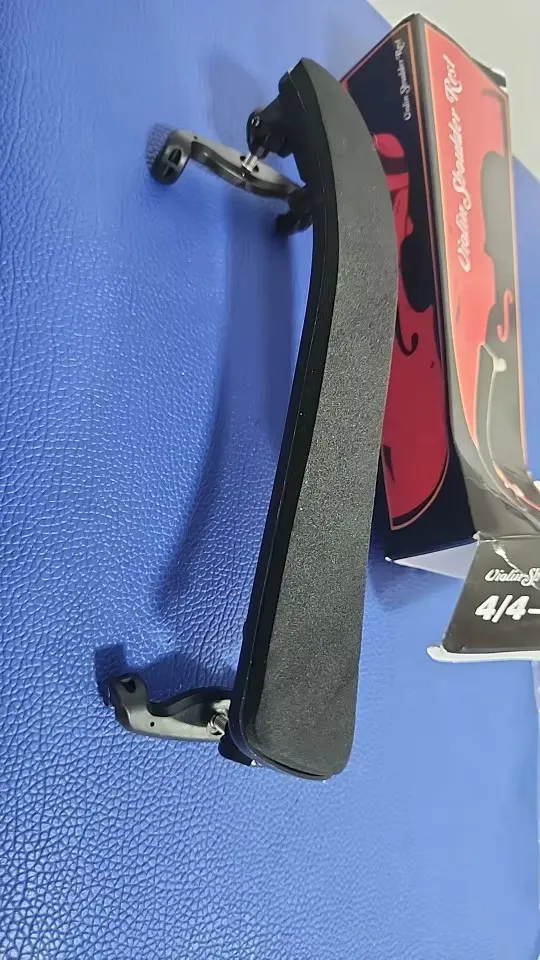
"Looks and feels better made than I expected at this price. The foam pad is comfortable and it sits flush against the violin."
— Daniel K., verified buyer

"Arrived complete. The shipping box was a little dented, but the rest itself was perfect and it holds my 4/4 nicely."
— Sofia L., verified buyer
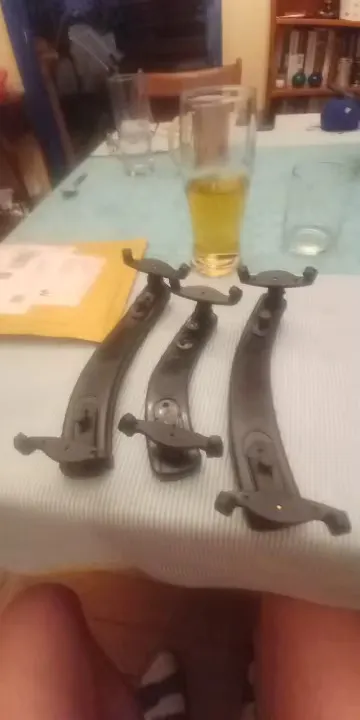
"Great little rest for my student violin. Light, simple, and the feet fold flat so it slips right into the case."
— Rebecca H., verified buyer
Photos are unedited and submitted by verified buyers.
Reviewed and updated July 19, 2026. See how we test and more about our store and mission.
Violin shoulder rest questions, answered
What size violin shoulder rest do I need?
Cadenza comes in two sizes. The Full / Three-quarter model fits full-size (4/4) and most three-quarter (3/4) violins, and the Small model fits quarter (1/4) and eighth (1/8) student violins. If you play a half-size (1/2) violin, neither model is a clean fit, so measure your instrument first and check our sizes page before you order.
Does the shoulder rest slip or fall off the violin?
It stays put when the feet are seated snugly on the ribs of the violin. A few players report it loosening, and that almost always traces back to feet that were not pushed fully onto the edge. Hook the wider concave end first, press the smaller end down with your thumb, and check both feet grip the rim. If it still will not hold for you, the 30-day guarantee covers you.
Does this shoulder rest fit a viola?
No. Cadenza is sized for violins, not violas. A viola body is wider across the lower bout, so the feet on the 4/4 violin model will not span it correctly. If you play viola, look for a rest built for viola dimensions rather than forcing a violin rest onto it.
Is the shoulder rest adjustable?
The two feet pivot on thumbscrew joints, so you can change the width and angle to match your collarbone, and they fold flat for storage. It is a fixed-arch design rather than a tall adjustable tower, so it raises the violin a modest, comfortable amount rather than lifting it several inches.
What is the shoulder rest made of?
The frame is black plastic with a foam-cushioned arch over a slim metal core, and the feet are plastic with grippy tips that clamp onto the edge of the violin. It is a practical, lightweight rest at a beginner-friendly price, not a solid-wood or carbon studio piece.
How do I put the shoulder rest on my violin?
Turn the violin over with its back facing you, hook the larger concave end onto the left rib first, then slide the smaller end into place while pressing down gently with your thumb. Check both feet are seated on either side of the body. Our step-by-step fitting guide walks through it with photos.
How long does shipping take?
Orders are dispatched within 1-2 business days and arrive in about 8-10 business days with tracking. US shipping is free. You will get a tracking link by email once your rest ships.
What if the shoulder rest does not work for me?
Every Cadenza order is backed by a 30-day money-back guarantee. If the fit is wrong or you are not happy for any reason, contact us within 30 days and we will make it right.
Give your violin a steadier hold
Pick your size, and it ships free in the US with a 30-day money-back guarantee. Still unsure which model fits? Start with the sizes guide.
Choose your size →