· Nadia Rahman
Violin vs viola shoulder rest: what is the difference?
Players who double on violin and viola often ask whether one rest can serve both. The honest answer is that it depends entirely on the viola's size, and mostly it cannot. This guide explains why, with the actual measurements, so you buy the right rest instead of fighting a poor fit. We make a violin rest, and we will tell you plainly where it works on a viola and where it does not.
Violin and viola are sized differently
Violins use fractional sizes, from 1/16 up to 4/4, where 4/4 is the full adult size with a body around 356 mm. Violas do not use fractions; they are measured by body length in inches, and there is no single full size. Adult violas typically run from 15 to 16.5 inches of body, and some players use even larger instruments. Student violas come smaller, around 12, 13 and 14 inches. That difference in how the two instruments are measured hints at the real point: a viola is simply a bigger box, and the shoulder rest has to span it.
| Instrument | Typical body length | Rest span needed |
|---|---|---|
| 4/4 violin | 356 mm (14 in) | Around 20 cm (our big model) |
| 14 in viola | 356 mm | Close to a full violin |
| 15 in viola | 381 mm | Wider than a violin rest |
| 16 to 16.5 in viola | 406 to 419 mm | Full viola rest only |
Why width is the real issue
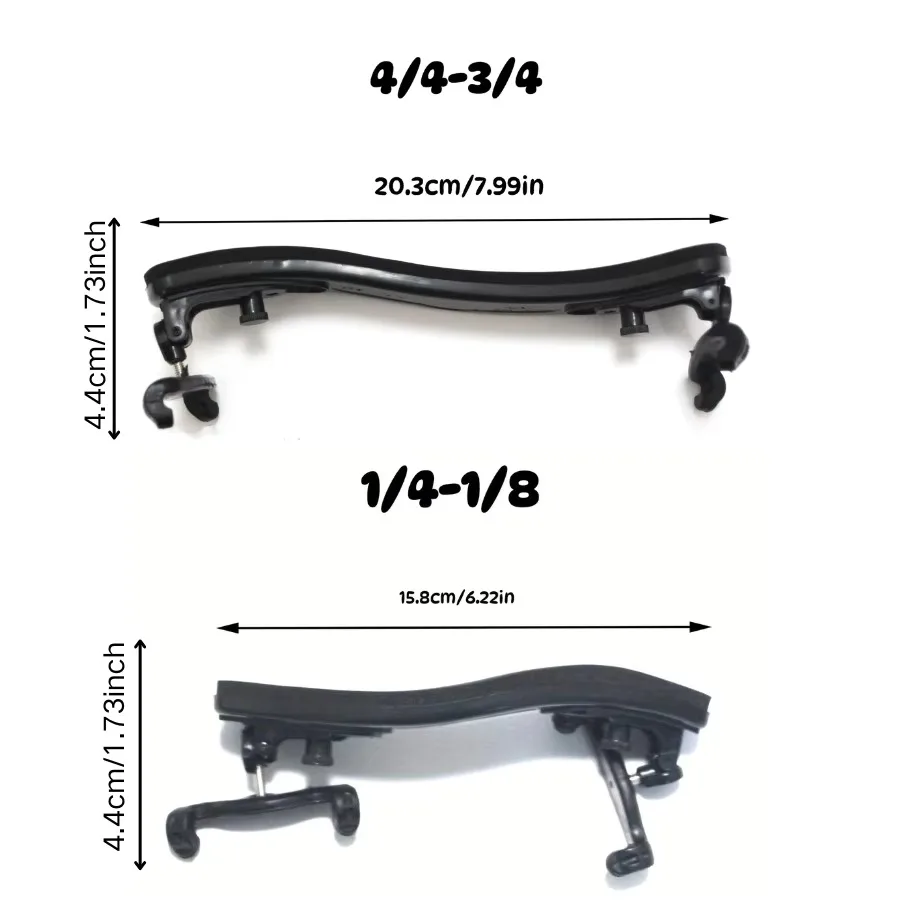
This is the same principle behind every fit problem with rests: if the span is wrong, the feet cannot seat. On a violin, our big rest spans 20.3 cm and its feet close on the lower bout nicely. Put that same rest on a full-size viola and the body is simply too wide for the feet to reach around, so it perches instead of gripping. No amount of tightening fixes a span that is fundamentally too short. It is the mirror image of the problem we describe for oversized rests in our violin sizes guide, where a rest too wide for a small violin also fails to grip.
When a violin rest can fit a viola
There is one honest exception. A 14-inch viola has a body length close to a full-size violin, so its lower bout is only a little wider. Our big rest, with its pivoting feet, can sometimes span a small 14-inch viola well enough to use as a stopgap, for example if a young player is between instruments. We would call that a temporary fix, not a recommendation, and we would not claim the rest is a viola rest. Once the instrument reaches 15 inches or more, a violin rest is out of its depth and you need a rest made for viola. Being clear about this is the same standard we hold everywhere, including admitting our violin range does not cover the 1/2 violin size.
prevalence range of playing-related musculoskeletal disorders in string players, violists included
— Systematic review, Journal of Manipulative and Physiological Therapeutics, 2018
Choosing a viola rest
If you play viola, buy a rest made for it. Match the rest to your viola's body length in inches, prioritise a wide enough span and enough height, since the larger instrument sits differently on the shoulder, and set it up with the same posture principles we cover in using a shoulder rest for posture. The violist's larger reach and heavier instrument make comfortable support if anything more important than on violin, which is why the elevated-arm strain research applies just as much.
daily elevated-arm playing above which neck and shoulder pain climbs, and viola sits the arm higher still
— Work postures and neck-shoulder pain among orchestra musicians, Am. J. Ind. Med., 2007
For violin, though, our rest does its job. If your instrument is a violin, see the buyer's guide, get the fit right with the setup guide, and read whether you even want a rest in the first place in do you need a shoulder rest.
More: real buyer reviews, how we test, and about Cadenza.
Questions
Can I use a violin shoulder rest on a viola?
Sometimes, but only on the smallest violas. Our big violin rest spans 20.3 cm, which can reach across a roughly 14-inch viola whose body is close to a full-size violin. On a standard 15 to 16.5 inch viola it is too narrow to grip, so a viola-specific or wider adjustable rest is the right choice.
What is the difference between a violin and viola shoulder rest?
The main difference is width. A viola has a larger body and a wider lower bout than a violin, so a viola rest spans further and its feet reach wider. Many are also adjustable to a taller height. A violin rest is built around the narrower violin body and may not stretch across a full-size viola.
What size shoulder rest does a viola need?
Match the rest to the viola body length, which is measured in inches, not fractions. A 15 to 16.5 inch viola needs a full-size viola rest. Smaller student violas around 12 to 14 inches use smaller rests, and a 14-inch viola sits close to full-size violin territory.
Is our rest suitable for viola?
Our rest is a violin rest, sized for 4/4 and 3/4 violins in the big model and 1/4 to 1/8 in the small. We do not market it as a viola rest. It may fit the smallest violas as a stopgap, but for a proper viola fit we would point you to a rest made for viola.
Free shipping · 30-day money-back guarantee